
Choosing (and Changing) Your Business Structure
The formalities of choosing how to structure your business and completing the proper filings can be intimidating. Many businesses experience constant change and evolution, which may leave owners wondering whether the structure they initially selected still best suits their business. This article aims to ease those concerns by providing a practical guide that business owners can use when deciding which business structure suits their needs.
The article will have six sections:
- Liability
- Taxes
- Capital
- Management
- Administrative
- Exit
Each section will outline how to approach each consideration to make the best decision regarding your business structure.
- Liability
This section is focused on helping business owners assess their risk tolerance and make mindful decisions without carrying any unnecessary risk. To do so, the picture below shows the personal liability offered from each structure, with a brief description:
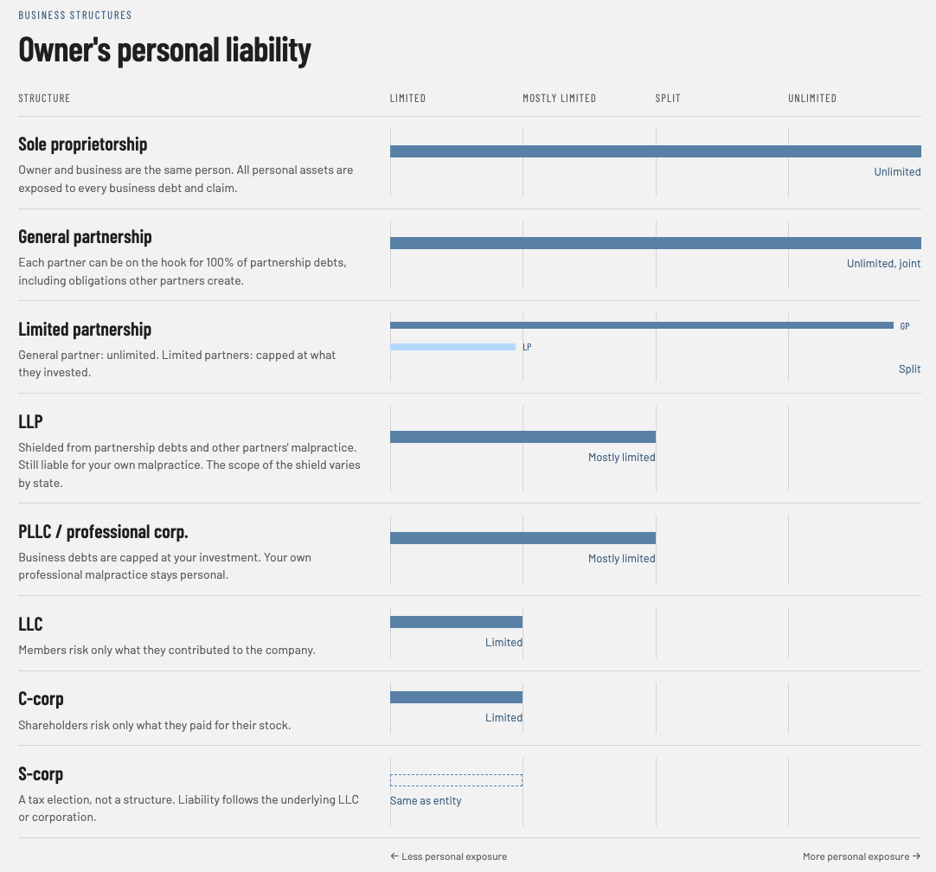
There is no single best business structure. Each has tradeoffs, and owners should weigh them when deciding which direction to take. The chart shows that sole proprietorships and general partnerships have unlimited liability, meaning the owners’ personal assets are not protected by the business structure. In those two structures, if the business incurs debts or faces legal claims, your personal assets could be at risk. Note the treatment of S-Corps: an S-Corp is not a business structure in and of itself, but rather a tax election made by an eligible corporation or LLC to change how the business is taxed.
Limited Liability Companies (LLCs) generally protect an owner’s personal assets from business liabilities. However, owners should avoid commingling personal and business funds. Doing so may allow a court to disregard the LLC (“pierce the veil”) and expose the owner to personal liability.
Importantly, limited liability will not cover an owner’s own wrongful acts or debts that were personally guaranteed.
- Taxes
The key tax question is how many times the business’s income is taxed, and why some owners deliberately choose structures that appear to be taxed more. Sole proprietorships and partnerships are “pass-through” entities: the business itself pays no federal income tax. Instead, owners report their share of profits on their personal returns, whether or not those profits are distributed, and generally pay both income tax and self-employment tax on them. By default, a single-member LLC is taxed like a sole proprietorship, and a multi-member LLC is taxed like a partnership. LLCs also offer more flexibility: an LLC may elect to be taxed as a corporation, and many LLCs elect S-Corp status to reduce self-employment taxes.
C-Corporations are taxed at both the entity and individual levels, resulting in double taxation of distributed profits. At the entity level, corporations pay a flat 21% federal tax on their profits, plus any applicable state taxes. When the remaining profits are distributed as dividends, shareholders are taxed again, generally at qualified dividend rates of 0%, 15%, or 20%, depending on their income, plus the 3.8% net investment income tax for higher earners.
S-Corporations follow a different taxation model. S-Corps generally do not pay federal income tax at the entity level. Owner-employees must pay themselves a reasonable salary, which is subject to payroll taxes, but the remaining profits pass through to the owners without self-employment tax. What surprises many owners is that shareholders are still taxed individually on their share of profits, whether or not those profits are actually distributed.
Remember, pass-through entities tax profits only once – on the owners’ returns. C-Corps are taxed twice on distributed profits. C-Corps can still make sense for businesses that plan to reinvest earnings or raise outside capital.
- Capital
This section focuses on where funding for the business will come from and what that means for choosing a structure. If an owner is looking to raise outside capital, sole proprietorships and partnerships are less attractive because they cannot issue stock. Corporations are often preferable for equity financing because they can issue different classes of stock. Note, however, that an S-Corp is limited to 100 shareholders, generally must have only U.S. individual shareholders, and may have only one class of stock, which makes it unsuitable for most institutional investors. LLCs also have advantages, offering flexibility through membership interests that can be structured in multiple classes.
Overall, the question for business owners is whether or not they are looking for investors. If so, the decision may be heavily influenced by the investors.
- Management
Business owners should consider how they want their business to be managed and who will manage it. Sole proprietorships and partnerships are simple. In a sole proprietorship, it is all on you. In a partnership, control and responsibility are shared. This added complexity creates a strong need for the presence of properly drafted partnership agreements. Although not legally required, it is a simple step to take to avoid future complications.
LLCs and Corporations introduce another level of complexity. Corporations have a more formal structure. Shareholders elect a board of directors that dictates the overall direction of the business. The state of incorporation also may impose additional filing requirements and obligations. LLCs strike a nice middle ground of being more complex than a sole proprietorship while offering more flexibility than corporations. LLCs give you the option of self-management or appointing managers.
Whatever structure you choose, the decision-making rules of your business should be clearly outlined in writing before you need them.
- Administrative
Administration of your business is similar to the management structure in that sole proprietorships are the easiest, corporations are the most complex, and LLCs fall somewhere in the middle. A sole proprietorship can start immediately, but you may still need local licenses. Although corporations and LLCs require more paperwork, it is not as complex as it may seem. Good legal assistance can help you set these up relatively quickly.
LLCs require filing articles of organization with the state. Additionally, adopting an operating agreement, although not required, may be a worthwhile investment to avoid future headaches. Corporations require similar filings in addition to creating bylaws and conducting other formalities such as detailed record keeping and regular board meetings.
The administrative work should not be a critical factor in deciding which structure best suits your business’s needs. With good guidance, formation and upkeep are routine.
- Exit
Exit strategies are highly individual. The traditional tension is whether an asset sale or an equity sale is best for the parties involved. Buyers often prefer asset sales because they can generally choose which liabilities to assume and receive a stepped-up basis in the acquired assets. Sellers often prefer equity sales because they transfer the entire business, including its liabilities, and typically produce a single level of capital gains tax.
In C-Corps, the double taxation problem reappears at exit. In an asset sale, the corporation first pays tax on the gain from selling its assets; when it then distributes the proceeds in liquidation, shareholders pay tax again on the amount by which their distributions exceed their stock basis. An equity sale avoids the corporate-level tax, but the buyer takes the assets with their existing (carryover) basis rather than a stepped-up basis.
Business owners who make an S-Corp election have additional flexibility that may help resolve this tension. In certain circumstances, the sale of S-Corp stock can be treated as an asset purchase for tax purposes. A Section 338(h)(10) election, which requires a corporate buyer, is made jointly by the buyer and the S-Corp shareholders; a Section 336(e) election is available where the buyer is not a corporation. Alternatively, the seller can complete an F-reorganization before closing, converting the target into a single-member LLC owned by a new S-Corp parent, so the buyer can purchase LLC interests that are treated as assets for tax purposes. When both sides agree to one of these approaches, sellers can sell equity while the buyer still receives the stepped-up basis of an asset sale.
Owners concerned about their business outgrowing its initial structure should understand the costs of making a change. Converting from a C-Corp to an LLC is treated as a complete liquidation for tax purposes, which can trigger tax at both the corporate and shareholder levels on any appreciation in the business’s assets. By contrast, converting from an LLC to a C-Corp is usually tax-free under Section 351 if the owners contribute their LLC interests (or assets) to the corporation in exchange for stock and together control at least 80% of the corporation immediately afterward.
Business owners who are unsure of their growth or exit strategies should lean toward forming an LLC. An LLC offers the most flexibility, can elect corporate or S-Corp tax treatment later, and can be converted to a C-Corp with relatively little tax cost.
Overall, most owners can narrow their choice by answering a few questions:
- Are you raising venture capital? If so, start as a C-Corp
- Are you solo and testing an idea? Although a sole proprietorship can work, a single-member LLC adds protection for little cost
- Are you unsure of where the business is headed? An LLC keeps your options open
Your structure does not have to be permanent, but some changes are significantly easier and less expensive than others.